The Kitchen Table Method is open. $109 once, yours for life
The Kitchen Table Method

You want to do more with them at home. The craft box just never feels worth it.

Valando Demetriou

A simple way to do art at home with your 2 to 8 year old, so it is easy to start and you do not need to be arty.

  • "I can't" becomes "not yet"
  • Focus that grows, a few minutes at a time
  • Something to do that is not the iPad
  • The hands and focus school asks for, with no worksheets

A few minutes of listening tonight, and tomorrow you will know exactly what to put on the table and what to say.

No prep mountains. No Pinterest spirals. No art degree.

Get it now, $109 $109 once, yours for life
★★★★★ our studio's 28 Google reviews, every one five stars15 years of teaching78,000 follow along on InstagramFamilies in Australia, Germany and France already use it
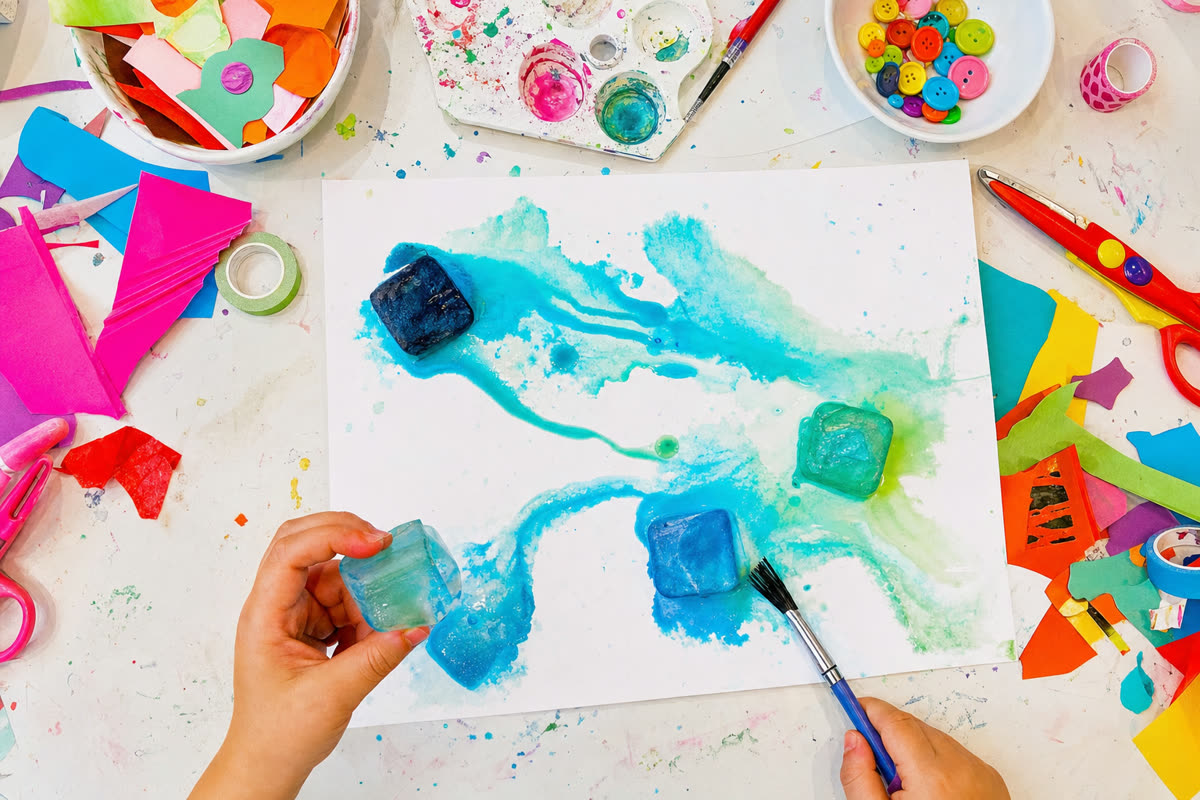
A child's hand painting watercolour over a block of ice on white paper
Painting on iceTonight, freeze a bowl of water.
Sound familiar?

Breakfast is done. It's not even 9am, and you're already out of ideas.

Want to do more at home. No idea where to start.
School is coming, and you're quietly panicking.
Same playgroup. Same activities. On repeat.
The craft box stays shut. Never worth the mess.
Done in three minutes, before you've sat down.
The iPad is the easy answer, and you feel guilty.
"I can't." "You do it." They won't give it a go.
Scared of mess, or a meltdown when it looks wrong.

Nothing is wrong with your child.
You are not doing it wrong.
Nobody hands parents this part.

I watch it every day at the studio: the child who arrives mid-tantrum is calm, absorbed and proud twenty minutes later. You don't need a studio. You need a table and the right words.

A quick quiz about your child

Five questions. Tap yes or no.

Do small things turn into big meltdowns? The wrong cup, a tower that falls, a line that "went wrong"?

Why the box stays shut

You're right: the craft box isn't worth it.

It's a whole project to get out, they give up fast, and the mess lasts longer than the fun. Of course it stays shut.

The usual way

  • ✕A whole project to get out
  • ✕"I can't." "You do it."
  • ✕Over in minutes, then the screen goes on
  • ✕Mess that outlasts the fun

Not worth it.So the box stays shut.

The Kitchen Table way

  • ✓Out in 30 seconds
  • ✓No example to copy, so nothing to get wrong
  • ✓Focus that grows a few minutes at a time
  • ✓Mess planned for: old clothes, a wipeable cloth

Worth it.So it actually happens.

So what actually changes? Three simple things. ↓

How it works

You learn first. Then you do the activities.

Most programs hand you a list of activities and hope. This one changes how you run the table first, in a really simple way, so every activity works. Everything in Part 1 comes down to three things:

1Take the example off the table, so it is their art.No finished sample for them to copy. Just the materials.
2Describe what they did instead of judging it."You used so much blue" instead of "good job".
3When they say "I can't", add the word "yet"."I can't" becomes "I can't yet".

Do those three things with any material, on any day, and you are doing exactly what we do in our studio. Here is how you learn them:

1

Listen to Part 1 first

The welcome and six short lessons, about 18 minutes in all. Play them while dinner cooks or in the car. This is where you change.

2

Try one small thing

Every lesson ends with one thing to do this week. Set up a corner. Say one thing, then count to twenty in your head. Say "not yet".

3

Then run a session

Print the card, sit beside them, and put no example on the table. It works because you have already changed.

… The amazing thing about this course is that taught me how to teach first which actually made all the difference in the world, thank you so much.

A mum who used it

Here is what that looks like at your table. ↓

What actually changes

This is not a list of crafts. It changes how you run the table.

Art at home fails for the same six reasons in almost every house. Each one has a fix, and the fix is what you learn in here.

1

"Getting the box out is a project, and so is putting it all away."

Starting stops being a project

What you'll see: The box actually comes out, because getting started takes thirty seconds instead of a project.

How you do it

You set up one corner that is allowed to get messy and one box they can reach on their own. Everything in the box is a yes, so you stop saying no twenty times. Paint lives up high and comes down when you are sitting beside them. You protect the table once, properly, and you plan for the mess instead of fighting it.

In the course: Part 1, lesson 2: Set up a corner that says yes

I hateeee doing things at home because of the mess but this course has changed my life and my relationship with my kids!

One of the first mums to try it

2

"They copy the example, theirs looks different, and it all falls apart."

No example, no meltdown

What you'll see: A child who gets on with it, instead of checking whether theirs matches.

How you do it

You take the example off the table. With nothing to copy, there is nothing for theirs to get wrong. You set the materials out so they look interesting, say one thing, and then you wait. The pause feels long. That is the technique, and the lesson shows you how to hold it, and how to introduce a material so they actually explore it.

In the course: Part 1, lesson 3: The first two minutes

My daughter is 4 and still holds the paint brush with one hand and squishes it down. How to introduce the materials was a game changer for me.

A very happy mum from Germany

3

"I can't do it." "You do it." They won't even give it a go.

"I can't" becomes "not yet"

What you'll see: A child who is more willing to give it a go, because a hard bit is no longer a reason to stop.

How you do it

You learn the five-second reply that turns a wall into a step, and why "yes you can" makes them dig their heels in. You stop rescuing at the first sign of struggle, and instead of "good job" you describe what they did, which is what keeps them going the day it does not look right. If they hold back, you start small: you begin, say nothing, and let them join you, with a material where a wrong mark cannot show.

In the course: Part 1, lessons 4 to 6: Growth mindset, When they say I can't, When it goes wrong

WOW just WOW!! I listened to the entire thing in one night and got up the next morning and got into it with my girls. We had the most amazing morning and the tantrums have gone.

A mum who used it

4

"They are done in three minutes, so it is never worth getting the box out."

Three minutes counts

What you'll see: Focus that grows a few minutes at a time, and a short attention span you stop writing off as failure.

How you do it

Little children work in short bursts, and the course shows you what to do with that: a small invitation that brings them back, when to simply pack it away and try tomorrow, and why fifteen or twenty minutes, two or three times a week, beats a whole afternoon once a month.

In the course: Part 1, lesson 6 and Part 5: Keep it going

5

"I'm bored." And the iPad is the easy answer, again.

You stop being the entertainment director

What you'll see: The iPad stops being the only answer to "I'm bored", and you stop inventing a new activity every day.

How you do it

Bored is the feeling just before an idea, and you learn what to do with it: name it, give one nudge, walk away. A help-yourself shelf, an invitation you set out without a word, and ten ways to start from a single squiggle move the ideas over to them. That is how you cook three steps away while they make.

In the course: Part 4: Creating without you

6

"School is coming up. Are we doing enough?"

School gets what it asks for, with no worksheets

What you'll see: Hands, focus and keep-going growing week by week, and you can see it happening instead of wondering.

How you do it

Every session quietly builds what school asks of them: the grip to hold a pencil, focus, keeping going when it is hard, following a few steps in order, and talking about what they made. You learn what to look for, so you can see it growing. You notice it. You do not test it.

In the course: Part 5: Art that helps at school, and The stages of drawing

Anyone can hand you an activity list. This changes what you do at the table, so every activity you ever try works better.

Paint and the word art scares me so this was so easy to listen to and follow thank you

A mum who used it

And here is what it does for them. ↓

What your child gets

It looks like art. What it builds goes much further.

Six things you start to hear, and see. Each one is built into the way the course has you sit down with them.

Willing to give it a go

“I can't.”

“I'll give it a go.”

You'll see"I can't" turns into "not yet", and they try it a different way.

Why it mattersChildren who learn that a wobbly start is normal cope far better with the hard bits of learning to read and write.

Ideas of their own

“I'm bored.”

“I've got an idea.”

You'll seeThey reach for the shelf and start, instead of waiting to be entertained.

Why it mattersImagination is a muscle, and it only grows when a child has to use it.

Staying with it

“I'm done.”

“I'm not finished.”

You'll seeFocus grows a few minutes at a time, then a little longer.

Why it mattersA child who can stay with a painting for ten minutes is practising what sitting with a story will need.

Never "not the artistic one"

“Mine's wrong.”

“I made this.”

You'll seeTheir work is their own, with no example to match and no wrong answer.

Why it mattersMany children quietly decide around five or six that they are not the artistic one. This keeps that door open.

A head start for school

“Writing is hard.”

“I made a book.”

You'll seeFrom a fist grip to a neat pinch. Books they write, patterns, shapes, counting and measuring.

Why it mattersA study led by David Grissmer found fine motor skill at school entry predicted later reading and maths.

Feeling seen

“Is it good?”

“You noticed.”

You'll seeYou describe what they did and ask about their choices, instead of just saying "good job".

Why it mattersChildren become whatever we keep noticing out loud. They hear that the doing matters, not only the result.

These are not art skills.

They are the habits of a child who tries things, keeps going and believes they can get better.

They start at your kitchen table, and they are the kind of habits that carry into school and beyond.

Harvard's Center on the Developing Child describes the skills behind focus and self-control as ones we need "at every stage of life". Fine motor finding: Grissmer et al., 2010, Developmental Psychology.

This is what you are really buying: a child who tries, keeps going and has ideas of their own, and a way of sitting down with them that works.

or Klarna and Zip where available
Picture the next few weeks

The craft box comes out again, and this time it works.

Tonight

A few minutes of listening while dinner cooks. One lesson, and one small thing to try.

Tomorrow

One corner, one box, one sentence. No example on the table. You say one thing, then count to twenty in your head before you speak again, which is the hardest part.

A couple of weeks in

They start asking for it. Some mornings you hear "not yet" where "I can't" used to be.

When school comes up

You have been watching their hands, their focus and their keep-going grow, so you are not panicking. You can see it.

You do not need to be a teacher or an artist. You need a corner, a few words, and a table. We teach art to 3 to 6 year olds every day at Mini Ivy, and this is how we do it, made small enough for one family. Your Art Mum Era starts here.

The first mums to try it

What they sent me.

The first four are friends of mine who used The Kitchen Table Method with their own children before it opened, free of charge. The rest have arrived since. Every message is copied as it was sent; I have only tidied spelling and taken out a child's name.

Swipe for more →

WOW!! Valando THANK YOU!!! Ever since we moved to the hills and the girls haven't been able to come to Mini Ivy it has been so tricky but this course has really helped me be able to do these things with them at home without stressing!!!
Hey my love, I just wanted to say thank you so much for creating this! [My son] and I are absolutely LOVING our art time together and it makes me feel so proud that I can truly teach him while he is having a blast!
I hateeee doing things at home because of the mess but this course has changed my life and my relationship with my kids!
WOW!! Thank you so so much I am only up to lesson 3 and I am LOVING it so far!!!
Valando thank you so much for this! We made our art box yesterday and honestly it was so much fun and less stressful than I thought! I was really nervous about this because I'm constantly on Pinterest all the time and then when I try to do these things with my girls it just turns into mess and chaos. The amazing thing about this course is that taught me how to teach first which actually made all the difference in the world, thank you so much. I'm so excited to keep learning.
Hello from France I have been following you for such a long time and I'm so glad I bought this. It has been so fun in my house with my three and seven year-old.

A mum in France who bought it

I've always wanted to do these types of things with my boys at home and my two older ones are now in School so I am savouring every moment with my 2 1/2-year-old. Thank you for teaching me how to talk and thank you for guiding me through this process.
WOW just WOW!! I listened to the entire thing in one night and got up the next morning and got into it with my girls. We had the most amazing morning and the tantrums have gone.
My daughter is 4 and still holds the paint brush with one hand and squishes it down. How to introduce the materials was a game changer for me.

A very happy mum from Germany

Paint and the word art scares me so this was so easy to listen to and follow thank you
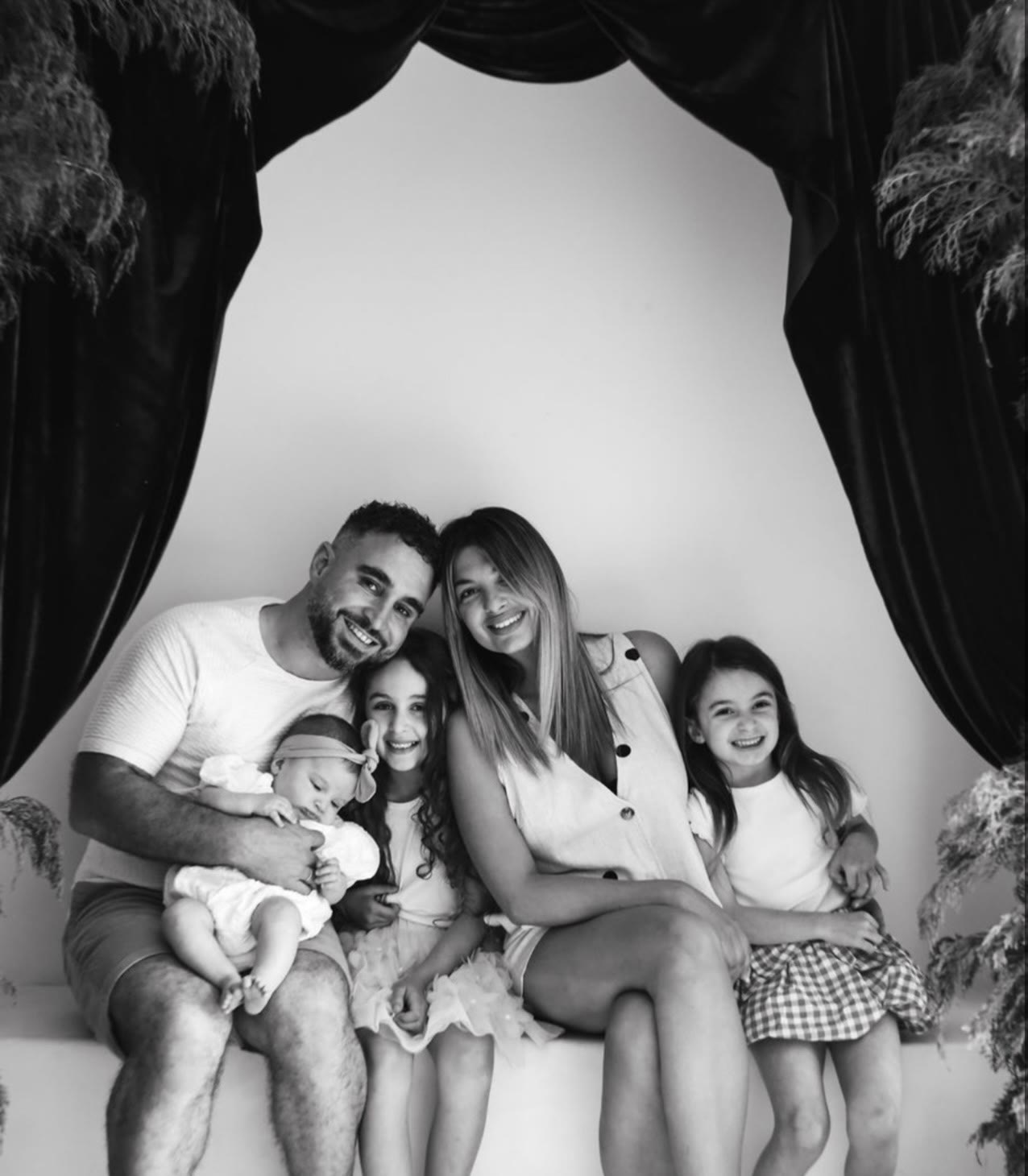
Valando Demetriou with her husband and their three daughters
Who I am

Hi, I'm Valando. I'm a mum of three girls first.

So I know what a long morning at home really looks like: someone hungry, someone tired, and a baby who wants whatever the big kids have.

When I was eight, my family moved from Cyprus to Australia. I started school three days later without a single word of English, and I cried every day because I missed my mum. I had the most incredible teachers. They taught me English and believed in me every step of the way, and they are the reason I became a teacher.

I have taught for fifteen years, eight of them teaching children in their first years of school, and four years ago I co-founded Mini Ivy, an art studio for 3 to 6 year olds in Torrensville, Adelaide. Parents kept asking what we do differently so they could do it at home. The Kitchen Table Method is my answer, in my voice, written for your table and your children.

Valando DemetriouCo-Founder, Mini Ivy · mum of three

I've done all the planning for you. Every word, every set-up, every age. All you have to do is sit down with them.

or Klarna and Zip where available
The proof behind the method

This is what it does to children. Parents' words, not mine.

The Kitchen Table Method is our studio's way, written out for home. These are real Google reviews of Mini Ivy from studio parents, word for word.

Swipe for more →

Tana M. ★★★★★
He has gone from struggling to hold a pencil and not showing an interest in art and always giving up to now excited to show me his new creations each week.
Samantha A. ★★★★★
Ever since my son started attending Mini Ivy, he has more confidence, more independence, his language has improved, his creativity at home is through the roof :-) … My only regret is not registering him a long time ago!
Ana K. ★★★★★
Enrolling our daughter with Mini Ivy was the best decision for her. … We’ve seen such a beautiful change in her confidence and her ability to express herself through art.
Mary K. ★★★★★
Charli was recently asked what her favourite part of the holidays were. Her answer, ever so proudly: ‘ART SCHOOL’. *me: cries with pride*.
Nikki A. ★★★★★
Our daughter attends her weekly art class and thrives. … It’s a highlight of her weekly co-curricular routine.

Every one of the studio's 28 Google reviews is five stars. Read them all on Google.

What's inside

29 lessons in five parts.

Tap a part to see what it does for you, and every lesson in it.

Start here

Welcome1 lesson

  1. Welcome to the Kitchen Table MethodWell done for being here. Listen to Part 1 first: it is short, and every session after it works better because of it.
Part 1

The way we do it6 lessons

The part that changes everything. Why art at home matters, a corner that says yes, the first two minutes, what to say about what they make, "I can't", and what to do when it goes wrong.

  1. Why art at home matters more than you thinkAsk: which bit was the trickiest? Then listen. You are noticing the doing, not the result.
  2. Set up a corner that says yesOne messy spot, one reachable box, and everything in it is a yes. Paint lives up high.
  3. The first two minutes: start without an exampleNo example on the table. Say: I wonder what you will do with this. Then count to twenty.
  4. Growth mindset, and what to say about what they makeMistakes are how we learn, so let them see yours. Describe their art, do not judge it.
  5. When they say I can'tName the feeling, add the word yet, and make the next step tiny. Then wait.
  6. When it goes wrongTake one breath and ask: is this a problem, or is this just what little children are like?
Part 2

Eight kitchen table sessions8 lessons

Eight sessions to run at home. Each has what you need, how to set up, the words to say, and a version for 2 to 3, 4 to 5 and 6 to 8.

  1. The very first markAsk for a kind of line, never a thing. Fast, slow, round and round, jumping.
  2. Painting on iceFreeze a bowl of water and paint on the ice. You cannot boss it around, and that is the lesson.
  3. A warm sky washWet the page first, tickle don't scrub, and let the colour bloom on its own.
  4. The foil treeOne twist turns a strip of foil into a branch. Let them build the rest.
  5. Dots on dotsDip and press is the whole technique. Dots are serious art, and they build the pencil grip.
  6. Snip, stick, buildFinger-wide strips mean one snip, one piece, instant success. Thumbs up, open, close.
  7. Kitchen printingAsk them to guess the shape first. Predict, print, check. Then make a pattern.
  8. Make a book togetherThey draw, you write their exact words, then read it back like a real book.
Part 3

The engineering hub at home5 lessons

Building, testing and problem solving with whatever is in your recycling. For the child who would rather build than paint.

  1. The engineering hub at homePut out materials and a challenge, then step back. When it falls, ask: what could you try differently?
  2. Build it tallWhen the tower falls, the session is only halfway through. Ask: why did it fall, and what will you try?
  3. Bridge itFold one sheet of paper into a zigzag and it holds the car. Shape is strength.
  4. Ramps and rollersChange one thing, then watch what happens. That is a real experiment.
  5. Junk modellingNothing goes in the bin until it has been something else first. The tricky join is where the learning is.
Part 4

Creating without you5 lessons

How to get them starting, imagining and making on their own while you cook three steps away. A help-yourself shelf, starters for when they are stuck, and the reply to "I'm bored".

  1. A child who starts without youYou are not leaving them to it, you are handing over the ideas. Ladder: beside you, near you, on their own steam.
  2. The invitation: set it out, say nothingThree materials, arranged with care, and not one word. Someone thought about you, and I wonder what you will do.
  3. The squiggle, and nine other startersOne squiggle has a thousand right answers, and every one has to come from them.
  4. While dinner cooksSet the table in thirty seconds, cook three steps away, and narrate from the stove. Ten minutes is a triumph.
  5. When they say I'm boredBored is the feeling just before an idea. Name it, give one nudge, and walk away.
Part 5

Beyond the table4 lessons

What school actually asks of them, the stages of drawing, and how to keep it going when life is busy.

  1. Art that helps at schoolHands, focus, persistence, following steps, and talking about their work. Notice, don't test.
  2. The stages of drawingEvery child moves through the same stages in the same order, at their own speed. Find the stage, describe what you see, and never ask what is it.
  3. Keep it goingLittle and often, same time and place, rotate materials, and display their work at their height.
  4. Where to go from hereTake the example away, describe instead of judging, and add the word yet. Then do it again.

That's all 29. You don't need to do them all at once. Start with one tonight and see how it feels.

or Klarna and Zip where available
Inside every session

The words to say are written down for you.

That is the part most parents are missing. Not the activity, the words. What to say when they start, when they get stuck, and when they hold it up and ask "do you like it?". Every session card has them, and a version for each age, so siblings can sit at the same table.

This is a real card from the course, and below is the whole lesson that goes with it. Print the card, run it tonight, and see how it feels before you spend a cent.

Listen free

Painting on ice, the whole lesson, a little over two minutes, in my voice.

Session card

Painting on ice

You need

  • A bowl, plastic container, muffin tray or a balloon, for freezing
  • Watercolours or washable paint watered right down
  • A brush or a dropper
  • A tray with a lip, and a towel
  • A pinch of salt, for older children

Set it up

  • The night before: fill your container with water and freeze it
  • In the morning, tip the ice onto a tray so the melt has somewhere to go
  • Pass the ice around before any colour goes on

The words to say

  • What does the ice feel like?
  • What do you think will happen when the colour touches it?
  • The ice is helping you paint. Look where the blue is travelling.

What it builds

Following what a material wants to do instead of fighting it. Observation, prediction, and flexibility, a core growth mindset skill.

Ages 2 to 3

One whole bowl of ice, far too big for a mouth, and no salt.

Ages 4 to 5

Muffin-tray ice in different shapes, so each one is a different canvas.

Ages 6 to 8

A pinch of salt first, so the colour races into the tunnels it melts.

What you could be creating

Half an hour, things you already own, and this is your table.

The method is not a list of crafts. It is how to run any make so it quietly builds something. Six examples, and what each one is teaching while they think it's just fun.

Swipe for more →

A giant finger-painted rainbow on a big sheet of paper
The giant rainbowMaths: patternsStrong hands2 min prepunder $2
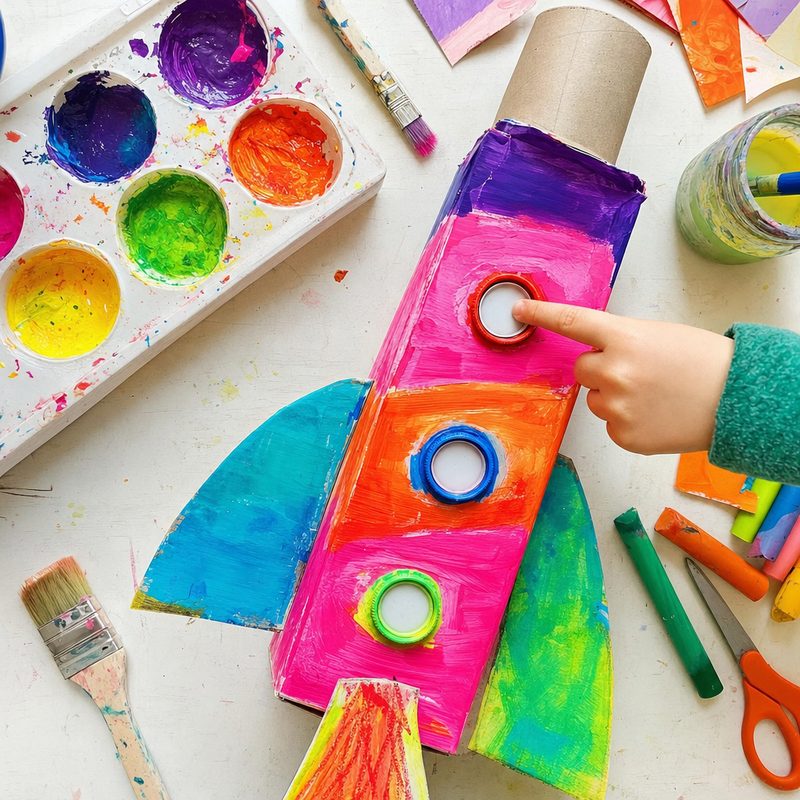
A rocket built from cereal boxes, half painted in bright colours
The cereal box rocketMaths: shapesTrying it themselves5 min prepfree, from the recycling
A whole-table painting with small hands and a grown-up hand painting together
The whole-table muralWords: talking about itTime together2 min prepunder $5
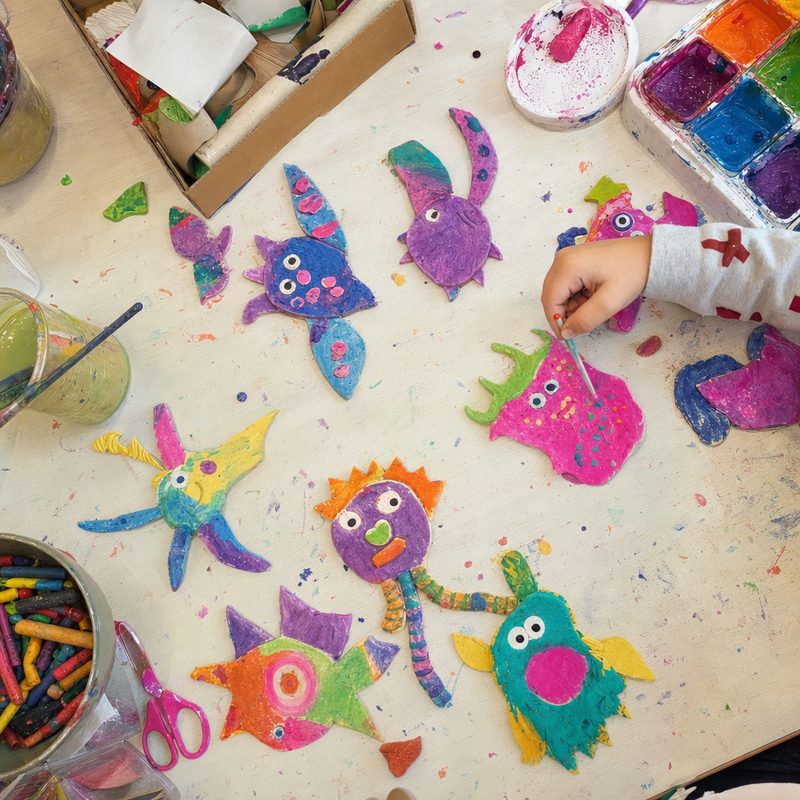
Little salt dough creatures painted in bright colours drying on a tray
Salt dough creaturesWords: pencil gripKeeping going10 min preppantry ingredients
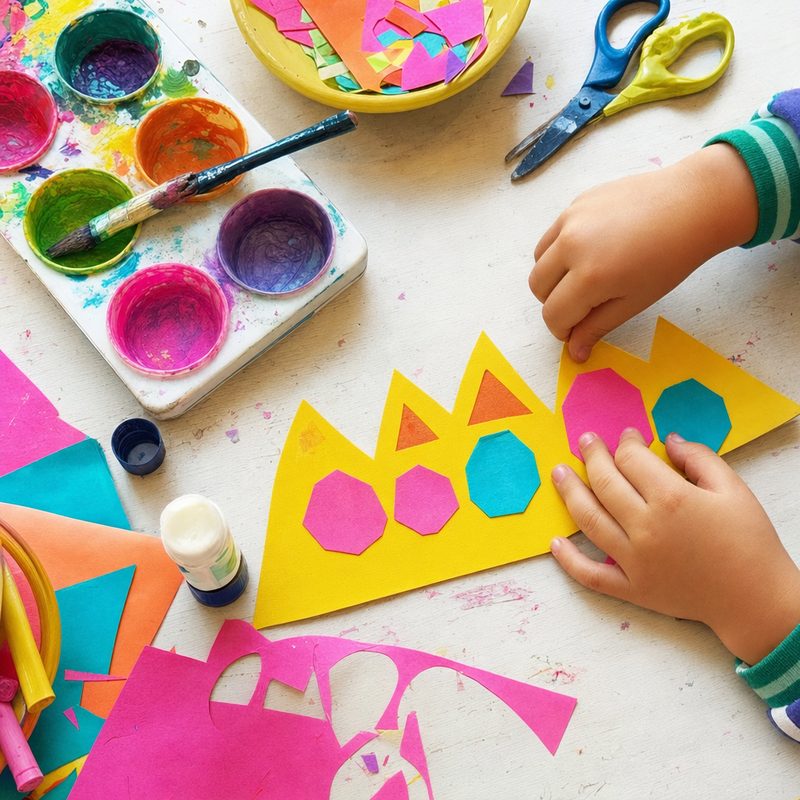
A bright paper crown with paper jewels being glued on
The paper crownMaths: countingScissor skills5 min prepunder $2
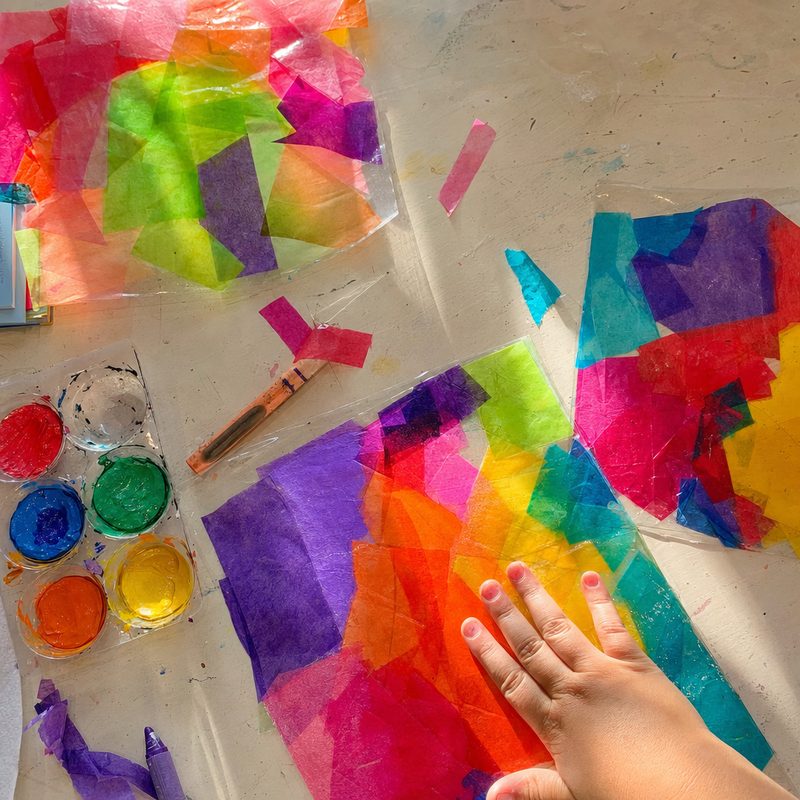
Bright tissue paper suncatchers glowing in a window
Window suncatchersMaths: shapesPredict and check5 min prepunder $5
If school is the worry

School is coming up. Here is what it actually asks of them.

You do not need worksheets. Little children build what school asks of them through making, and the course teaches you what to look for, so you can see it growing instead of wondering. It is not a checklist to pass: every child gets there in their own time.

Strong hands

Dotting, tearing, twisting and snipping move a fist grip toward the neat pinch a pencil needs. More play with dough, foil and cotton buds helps far more than drilling letters.

Focus

Can they stay with one thing for a few minutes, then a little longer? A child who can stay with a painting for ten minutes is practising what sitting with a story will need.

Keeping going

A wobbly start is normal and "not yet" is a real answer. Children who learn that cope far better with the hard bits of learning to read and write.

Following steps

Get the paper, get the paint, wash the brush between colours. Small routines are practice at following instructions.

Talking about their work

Explaining what they made, and why, builds the language they need to share ideas in class.

And the reading, writing and maths underneath

Early reading and writing

  • Make a book together. They draw, you write their exact words underneath, then read it back like a real book. Beginning, middle and end: the foundation of reading and writing.
  • Talking about their work. Explaining what they made, and why, builds the words they need to share ideas.
  • Hands ready to write. Dotting, tearing, twisting and snipping build the pinch grip a pencil needs.
  • Older children write their own words, with help only when they ask.

Early maths

  • Patterns. Printing with kitchen objects and making a repeating pattern, one of the earliest maths skills there is.
  • Shapes. Lines, circles and the shapes a block of ice melts into.
  • Counting and measuring. Measure the tower together. Count what the bridge holds, write the number down, and try to beat it.
  • Predicting and checking. Guess what will happen, try it, and see. The start of thinking like a scientist.
Get The Kitchen Table Method $109 once, yours for life
What the science says

This is not just craft time. The research on these years is loud.

The words you use matter

Stanford psychologist Carol Dweck's research found children praised for effort were more likely to choose harder challenges and keep going after a setback than children praised for being smart. Every session card scripts the effort words for you, so you say them without thinking.

Strong hands help strong learners

A study led by David Grissmer, following children from school entry, found fine motor skill predicted later reading and maths. Dotting, tearing, snipping and dough are that training, disguised as fun.

Focus is built, not born

Harvard's Center on the Developing Child says no one is born with the skills behind focus and self-control, but every child is born able to build them. It also describes responsive back-and-forth moments with an adult as what strengthens a child's early brain connections for communication, emotional wellbeing and social skills. Half an hour side by side at a table is exactly that kind of moment.

You don't need to read the studies. The set-ups, the sessions and the words in this course are built on this research, so your half hour at the table is doing what it says matters.

Sources: Mueller & Dweck, 1998, Journal of Personality and Social Psychology. Grissmer et al., 2010, Developmental Psychology. Harvard University Center on the Developing Child.

Where it started

A mum of twins said it first.

Cathy bought our course for educators, the Mini Ivy Method, to use with her twin boys. This is what she sent us, and it is why The Kitchen Table Method exists.

Wow, this is not at all what I was expecting.
I'm a mum and bought this to do with my twin boys, and honestly it has blown me away.
It has taught me how to teach them more at home and do things on my kitchen table.
Thank you so much.

Cathy, mum of twin boys, about the Mini Ivy Method

Is it for you?

Made for families.

It is for you if

  • You have a 2 to 8 year old, or a few of them
  • You want to do more with them at home and don't know where to start
  • The craft box stays shut because the mess and the short attention span never felt worth it
  • You're the mum, dad or nanna whose saved folder is full of ideas you have never once done
  • You've decided you're "not creative", and school is getting closer
  • You want something better than the iPad for the long mornings

It is not for you if

  • You teach a group or run a program. You want the Mini Ivy Method, our full course for educators
  • You want printables to hand over and walk away. This is about sitting down with them
Everything you gain

Here is everything you are saying yes to.

For your child

  • Willing to give things a go, because "not yet" replaces "I can't"
  • Ideas of their own, instead of waiting to be entertained
  • Focus that grows, a few minutes at a time
  • Never deciding they're "not the artistic one"
  • Hands, reading, writing and maths ready for school
  • A parent who notices what they do, not just what it looks like

For you

  • Starting takes thirty seconds, not a project
  • The exact words for "I can't", "is it good?" and the meltdown
  • A mess that is planned for, not fought
  • The iPad stops being the only answer to "I'm bored"
  • Ideas that come from them, not all from you
  • You can see what school needs growing, instead of wondering
TonightA few minutes of listening
TomorrowThirty seconds to set out
In a couple of weeksThe course says to expect them asking for it

All of it for $109, once. Yours for life.

or Klarna and Zip where available
Right now you have two options

Same table, two different years.

Here is the thing about the years between 2 and 8: focus, strong hands and keeping going are built now, and this is also the age when they still want to do it with you. It is never too late to start. It just never gets easier than today.

Option one: close this page

It costs nothing, and nothing changes. The craft box stays shut, the iPad comes out, and at 9pm you save another idea you will never do.

School gets a little closer, and you still do not know where to start.

Option two: spend $109, once

Tonight, a few minutes of listening while dinner cooks. Tomorrow, one corner, one box and one sentence, with no example on the table and a slow count to twenty.

A few weeks on, there is a wall of their work at their height, "not yet" is starting to turn up where "I can't" used to be, and school feels less like a worry.

Klarna and Zip where available
The Kitchen Table Method

Everything you get for $109.

This is not another activity list. Not a printable pack to hand over. Not more screen time. It is how a real studio teaches, scripted for your kitchen table.

★★★★★

“I'm so glad I bought this. It has been so fun in my house with my three and seven year-old.”

A mum in France, who bought it
The Kitchen Table Method
$109AUD, once, for the whole family

Here is the maths. One session at our studio is $52. The sessions in here would cost $676 there, before the exact words we teach with and the bonuses. You get all of it for $109, once.

  • Eight kitchen table sessions. Printable cards with a version for 2 to 3, 4 to 5 and 6 to 8, so siblings share one table$416 at the studio
  • The engineering hub at home. Five building sessions, for the child who would rather build than paint$260 at the studio
  • Creating without you. Five lessons that get them starting, imagining and making on their own steam, while you cook three steps awayincluded
  • 29 short audio lessons, in my voice. Every set-up and every word to say, including the ones for "I can't", "is it good?" and the meltdown moment. This is the part you cannot find on Pinterestyours for life
  • BonusTen challenge cards. For the 7 year old who says "I'm bored"free
  • BonusTen imagination starter cards. For the jar, so the ideas never run outfree
  • BonusThe stages of drawing chart. What you will see at every age from 2 to 8, and what to sayfree
  • BonusThe mindset cheat sheet. What to say instead, side by side, for the fridgefree
  • BonusThe box checklist. Set it up once, and stop hunting for the gluefree
  • BonusEvery new session we ever add. No subscription, no top-upsfree, for life
$676 of sessions at today's studio prices$676$109
And the $109 is never dead money.
  • Listen to a whole lesson free on this page before you pay a cent
  • It is yours for life, including every session we add later
  • Move up to the Mini Ivy Method within 30 days and every dollar you paid here comes off its price

Pay by card, or with Klarna or Zip where available at checkout. Secure checkout with Stripe. Prices are in Australian dollars, so outside Australia it costs less than the number you see.

What happens in the next five minutes
  1. Pop in your email and pay. It takes about a minute.
  2. Your course opens straight away, and the link lands in your inbox.
  3. Play lesson one. It's under three minutes.
  4. Tonight, freeze a bowl of water. Tomorrow is your first session.
Questions

Before you buy.

I've tried craft at home and it's never worth the mess. How is this different?

Because the problem is not the activity, it is everything around it. Getting the box out feels like a project, putting it away feels like a bigger one, and they are done in three minutes. The first part of the course fixes exactly that: one corner that is allowed to get messy, a box they can reach, paint kept up high, the table protected once, and the mess planned for instead of fought. Setting out an invitation takes about thirty seconds, and three minutes of focus counts.

My child won't give things a go, or doesn't like getting messy.

Lots of children are cautious, and the course does not start with a bowl of paint. The first session is a fat crayon and one colour, and later ones use one snip at a time or a single dot with a cotton bud. You learn how to use materials where a wrong mark cannot show, and with little ones, how to start first, say nothing and let them join in when they are ready. If their reaction to mess feels strong, or worries you, talk to their teacher or your doctor. This is art at the kitchen table, not therapy.

Why do I have to learn first? Can't I just do the activities?

You can start any session, but the first part of the course is the reason the sessions work. It is the welcome and six short lessons, about 18 minutes in all, and each one ends with one small thing to try. It comes down to three things: take the example off the table, describe what they did instead of judging it, and add the word "yet" when they say "I can't". Do those, and you are doing what we do in our studio.

School starts soon and I'm panicking. Are we too late?

No. Part 5 shows you what school actually asks of them: hands ready for a pencil, focus, keeping going when it is hard, following a few steps, and talking about their work. Every session builds those, with no worksheets, and you learn what to look for so you can see it growing. It is not a checklist to pass. Every child gets there in their own time, and if something genuinely worries you, talk to their teacher or your doctor.

I'm sick of the same activities. Won't I just run out of ideas?

That is what Part 4 is for. Instead of you inventing something every day, you learn how to hand the ideas over to them: a help-yourself shelf, an invitation you set out without a word, ten ways to start from a single squiggle, and a three-step reply to "I'm bored". The sessions and every new session we add keep the materials changing too.

My child melts down when things go wrong. Will this actually help?

That child is exactly who this was written for. A meltdown over a fallen tower or a "ruined" drawing is a child who believes it should be perfect first go. The course gives you the exact words for that moment, built on the psychologist Carol Dweck's growth mindset research, and the sessions give them safe, small practice at things going wrong and trying again. It will not end every tantrum this week. It gives both of you somewhere better to put the day, and the skills grow from there.

I'm not arty at all. Is this for me?

Especially for you. The activities are the easy part: paper, paint, ice, cardboard. What makes the difference is how you set them up and what you say, and that's all written down for you, word for word. The point isn't a beautiful picture. It's a child who tries, keeps going and talks to you about what they made.

I already have hundreds of ideas saved. Why pay?

Because ideas are not what is missing. This gives you the part the internet leaves out: how to set it up so it is easy to start, how to begin without an example, and the exact words to say when they get stuck or ask “is it good?”. One session at our studio is $52; the sessions in here would cost $676 there, plus every word we teach with, in one payment, yours for good.

My child won't sit still for more than two minutes.

That is normal, and there is a lesson on exactly this. Little children work in short bursts, so you learn a small invitation that brings them back instead of “keep going”, and when to simply pack it away and try another day. Focus grows a few minutes at a time across the weeks.

I hate the mess.

Most of us do. The second lesson sets up one corner that is allowed to get messy and a box your child can reach, with paint kept up high, so getting it out and packing it away stop being a project. Another lesson covers what to do when paint ends up on the floor anyway.

I work full time. When would I do this?

Each lesson is a few minutes of listening, so it fits in the car or while dinner cooks. The sessions work best little and often: fifteen or twenty minutes, two or three times a week, like the half hour before dinner or a Saturday morning.

My child is 7. Have we missed it?

No. Every session card has a version for 6 to 8 year olds that asks more of them, and there are ten challenge cards written for that age. For children already at school, art at home is the one place with no right answer and no mark out of ten.

Is this more screen time?

No. The recordings are for you, not your child. You listen on your own, then you sit down together with paper and paint. Your child never needs to look at a screen.

I'm not in Australia. Does it still work?

Yes. Everything you need is in an ordinary kitchen anywhere, and the course works on any phone, tablet or computer. Prices are in Australian dollars, so it costs less than the number you see.

What do I need to buy?

Almost nothing. Paper, a few washable colours, foil, a bowl of ice, cardboard and things from your recycling. Lesson 2 has a checklist of exactly what goes in the box.

My children are different ages. Does that work?

Yes. Every session card has a version for 2 to 3, 4 to 5 and 6 to 8, so they can sit at the same table doing the same thing at their own level.

Is it a subscription?

No. You pay $109 once and keep it for life, including every new session we add.

How do I get it?

Straight after payment you land on your course, and the link is emailed to you. It works on your phone, tablet or computer, and every recording can be saved for offline.

Can I move up to the full Mini Ivy Method later?

Yes. The Mini Ivy Method is our full course for educators. If you buy it within 30 days of this one, using the same email, what you paid here comes off its price.

Can I use it with a class or group?

It is licensed for your own family. If you teach, the Mini Ivy Method is the course for you. The full terms are on the licence page.

Can I get a refund?

It is digital, so the moment you have it you have all of it, and sales are final. If you want to try our way first, the free Kitchen Table Ten guide is here. Your rights under Australian Consumer Law are not affected.

Same table. Different morning.

Half an hour together, the right words, and art they are proud of. 29 short lessons and eight sessions. $109, once, for the whole family.

Get The Kitchen Table Method
The Kitchen Table Method · $109 once Get it